Early Trip Report for the 2024–2025 Bull Shark Season at Playa del Carmen
An early and unexpected start to bull shark season in Playa del Carmen has already raised questions—and offered a few surprises.
I was caught completely off-guard in late October when my shark handler friend, Hector “Tiburon” Martinez, sent me a message to inform me that they were about to open the tourism season at Shark Point in Playa del Carmen. An early November start date is very early, so I was surprised to hear that they had begun chumming and feeding the sharks weeks ago in early October. It seems that the presence of the bull sharks at the site had started early this year, so the seven license holders had little choice but to begin their lead-up feeding activities or risk the sharks disappearing before high season.
Shark Point is one of the most reliable seasonal aggregation sites for pregnant female bull sharks, making the timing of their arrival especially important to both science and tourism.
Now, this might seem like a good thing, but it’s not necessarily so. The preferred time to start bull shark season is just before peak tourism season starts in the Mexican Riviera—otherwise known as “high season.” This maximizes the amount of people who get to witness the sharks but also helps maximize the ratio of operating costs to revenue for the dive shops. A less-than-optimal start date means fewer customers and higher operating costs, since the seven shops must keep feeding the sharks to maintain their interest, customers or not. It’s a tough balance: start too early and you lose money; start too late and the sharks may not stick around.
The pre-season feeding is a regulated practice used to maintain predictable shark presence near the site, ensuring controlled conditions for divers and reducing the likelihood of the animals wandering into fishing zones.
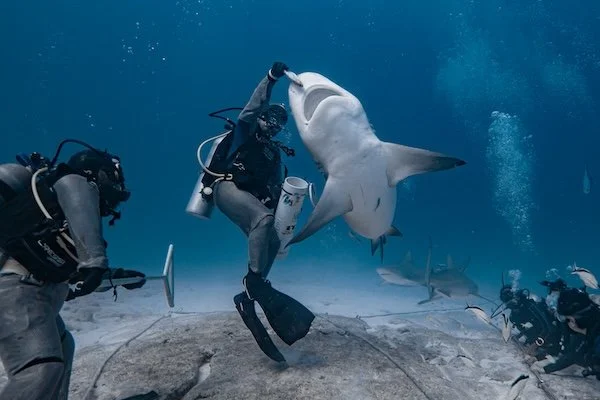
A bull shark approaches a diver during a controlled feeding at Shark Point—an early-season moment that set the tone for this year’s unpredictable start.
A second and more philosophical reason involves the growing unpredictability of the region’s wildlife seasons. The corresponding windows for whale sharks, eagle rays, and bull sharks in the Mexican Riviera have become far less reliable over the last few years. I previously wrote about the challenges of the 2023 whale shark season, and last year the bull sharks stayed at Shark Point until April—an unusually long and financially beneficial stretch for the dive shops. But this unpredictability keeps the spotlight on presumed shifts in migration patterns and ocean conditions often attributed to climate change. I, for one, subscribe to this theory, and while we can debate whether certain changes are good or bad, it’s widely accepted that sudden shifts in wildlife migration patterns are rarely a positive sign. It’s still too early to know what this season’s timing means.
So far, the season has been good. Some weather days caused strange shifts in current and visibility, but overall there has been a decent number of sharks—peaking at around 16 during my time there in November. There was an initial scare when the bull sharks suddenly disappeared from the site for a few days. This isn’t the first time this has happened, and it likely won’t be the last. Incidents ranging from human and fisherman intervention to theories about territorial disputes among the sharks have caused lapses in their presence at Shark Point. As of this writing, I’m not sure what happened this time around, but I got the opportunity to dive with Hector to look for the sharks, and the few we encountered were definitely behaving strangely. No telling what occurred, but if I find out more I’ll post about it later. Luckily, the sharks returned, and for now everything appears normal again.
I’m returning to Playa del Carmen at the start of December with the intent of documenting more bull sharks and eagle rays for most of the month leading up to Christmas. As always, I’m hoping for a great season filled with amazing encounters and stories. With any luck, this early start won’t foreshadow another unpredictable year—but only time will tell. CaaS